
Adam Andrews, Department of Biological, Geological, and Environmental Sciences, University of Bologna, Italy
Rachel Winter, Groningen Institute of Archaeology, University of Groningen, Netherlands
Willemien de Kock, Groningen Institute of Archaeology and Groningen Institute of Evolutionary Life Sciences, University of Groningen, Netherlands
SeaChanges project
SeaChanges (2019-2023) is a MSCA-multidisciplinary international training network of 15 PhD projects exploring long-term perspectives on the exploitation of marine vertebrates by integrating archaeology and marine biology. As a part of the training provided by the network, students undertake research secondments. Here we provide an account of our experiences at the University of York (UK) to complete collagen extraction and stable isotope analysis to contribute to our projects.
To briefly acquaint you with our projects, small summaries are provided below.
ESR 12 – Adam Andrews, University of Bologna, Italy. I am investigating adaptation in Atlantic bluefin tuna (Thunnus thynnus) throughout the last 6000 years in the Mediterranean and Black Sea. I combine genomics, isotopes, and morphological analyses to understand how adaptable this species was/is and how resilient it remains now which may allow us to predict how it may respond to future change.
ESR 13 – Rachel Winter, I am based at the University of Groningen in the Netherlands and am combining traditional zooarchaeology (NISP, osteometrics) with biomolecular archaeology (proteomics, stable isotope analysis) and marine ecology to understand the exploitation of groupers (Epinephelus spp.) in the Levant from the Bronze Age through the Hellenistic period.
ESR 14 – Willemien de Kock, also based at the University of Groningen I study the foraging ecology and genetic connectivity of ancient green turtles (Chelonia mydas) along the Levant. Sea turtle bones are found at various archaeological sites, but my research focuses on remains from Kinet Höyük (Turkey), Tell Fadous-Kfarabida, and Tell el-Burak (both in Lebanon).
Lab Experience during COVID
Conducting lab work during a pandemic is certainly a peculiar experience.
It was a trip that was stressful before it began; for the Groningen delegation it meant traveling despite the government advice. We discussed the most responsible route and decided to cross the North Sea by ferry from Rotterdam to Hull. Sea turtles are always complicated to send across borders as they are endangered and listed on CITES, even old bones require proof that they existed before the animal was added to the CITES convention (a condition which we satisfy by several thousand years!). Willemien managed to courier them to York just before Brexit officially kicked in on the 1st of January 2021 saving her from more paperwork, phew! Rachel however crossed the sea with extra luggage consisting of ancient Mediterranean fish (none are on the CITES list!), it’s a glamorous life.
Due to the pandemic, acquiring samples has been predictably challenging. Closures to museums and institutions responsible for granting permission to destructively sample these materials, has resulted in delays to this project where only a subset of samples have been analysed to date. Fortunately, bluefin tuna are not listed on CITES which would have complicated matters further.
Upon arrival into the UK, there were mandatory quarantine periods accompanied by the stress of hoping the courier finds the house and picks up our at home COVID tests, waiting for those results (negative, thankfully!), and then being permitted to arrange starting lab work. Once lab work commenced with regularity there are new considerations to going into the lab versus in non-covid times. For example, having to complete all of your training with colleagues at least 2 metres away and only being permitted a finite number of people in a space at any given time. To orchestrate all of this and ensure necessary precautions were taken, this further involved signing up on booking sheets for time slots in lab spaces, getting tested for covid twice a week, and when space was limited, working in slightly atypical spaces (casting sidelong looks to the zooarchaeology laboratory).
Of course, for one of us (the Englishman), quarantine was a relaxing (and merry) stint at home over the Christmas break.
Whilst we could access lab space and prepare samples for isotopic analysis, the experience was (not shockingly) simply incomparable with pre-pandemic times. Despite this, we still shared jokes in the lab that lightened the mood and made us feel very welcome and positive about the research. Even with so few colleagues around, we were very well supported when teething problems in new protocols/equipment arose and are grateful to everyone in BioArch at the University of York for enabling us to complete our lab work as planned.
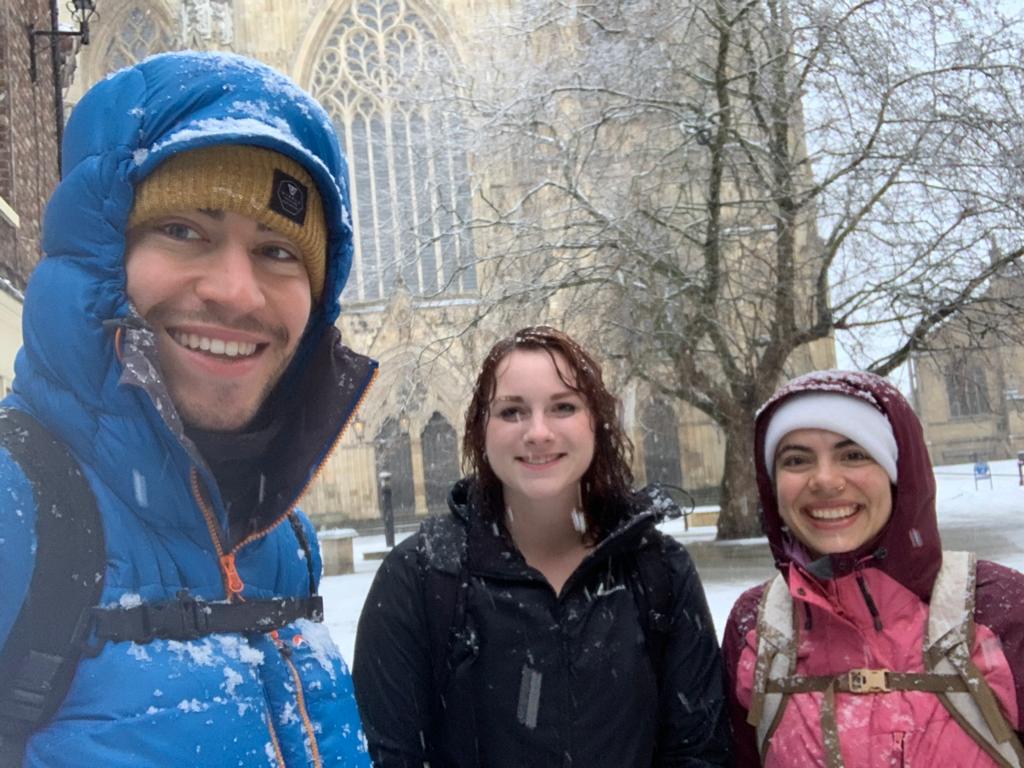
Adam (left), Rachel (center) and Willemien (right) in front of York minster.
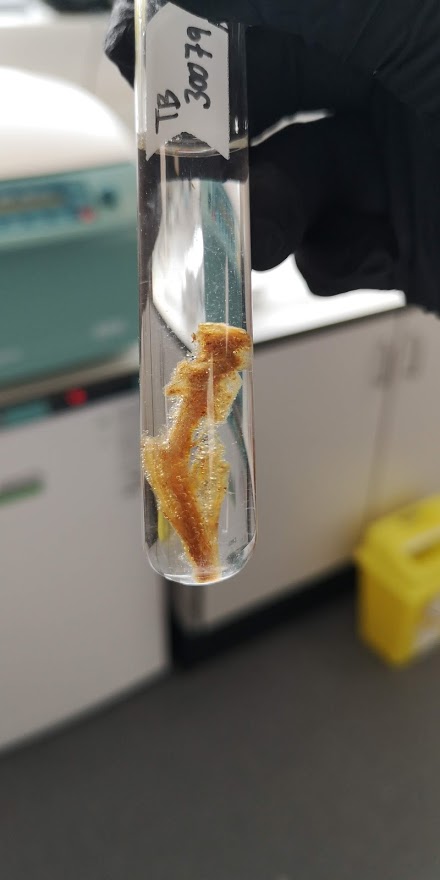
The three of us managed to extract collagen from an impressive number of samples (nearly 500 in total) and we were lucky that the York BioArch crew were so patient with us especially when we were using ALL of the test tubes. There was not much else to do except work, but eventually that played to our advantage when we saw the collagen come out of the freeze-drier looking exactly like cotton-candy – admittedly not as sweet but just as satisfying.
Stay tuned for the results coming to a journal near you!


 Stable Isotopes in Zooarchaeology