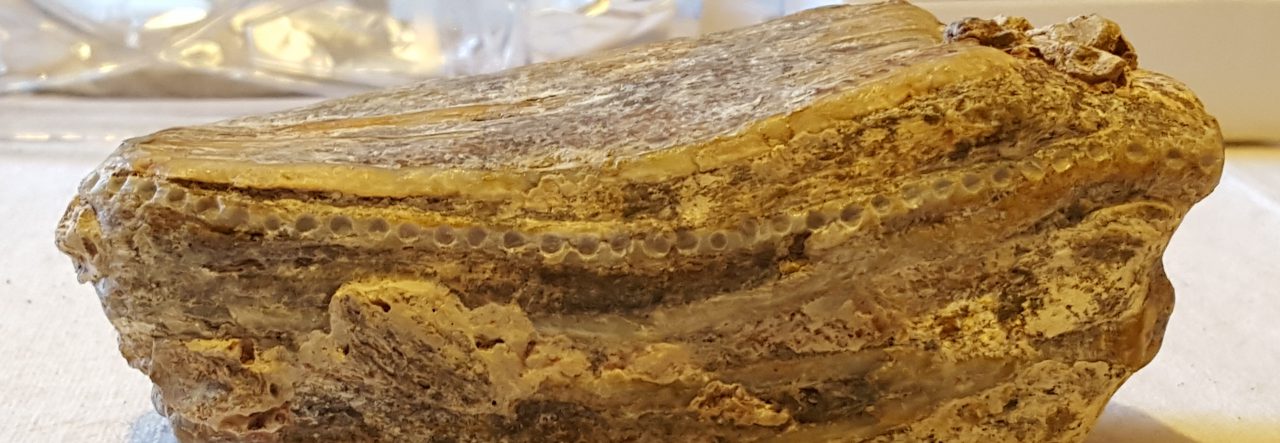
We’re back with new blog posts after a short summer hiatus. Our first post of the academic year (which has already begun for some of us in the US!) comes from David Orton, who is currently an Early Career Research Fellow on the EUROFARM project at University College London, where he is also a Teaching Fellow in Zooarchaeology. Here he shares research that was conducted during his previous postdoctoral fellowship at the McDonald Institute for Archaeological Research at the University of Cambridge, which was recently published in Antiquity.
—
A Meta-analysis of Archaeological Cod Remains as a Tool for Understanding the Growth of London’s Northern Trade
The backstory to this research comes in two parts. First, a landmark zooarchaeological study by James Barrett and colleagues (2004) demonstrated an explosion in marine fish consumption in England within a few decades of AD1000. Before this event – dubbed the ‘Fish Event Horizon’ (FEH) in tribute to Douglas Adams – sea fishing seems to have been rare and small-scale.

Second, James and his team applied stable isotope provenancing of cod bones to test whether this FEH represented a local phenomenon or the early onset of long distance trade from northern waters (full disclosure: I joined the project towards the end of this stage, in 2010). δ13C and δ15N signatures were established for six potential fishing regions using 259 samples from more than 10 countries. Applying this ‘target’ specimens from 23 (post)medieval sites around the North Sea (Barrett et al. 2011) and Baltic (Orton et al. 2011), we showed that a significant trade in northern cod existed by the 13th-14th centuries, but that the initial FEH in England primarily entailed local fishing. This raised more questions: when exactly did the trade start, how suddenly, and did the imported fish supplement or replace local catches?
Our new study, just published in Antiquity, combines a new zooarchaeological meta-analysis with the existing isotopic results to tell a clear story regarding cod imports to the city of London. Both elements rely on the same principle: that cod were traditionally decapitated before preservation for long-range trade, and that cranial elements thus normally represent relatively local catches. This allowed us to use head bones to establish regional isotopic signatures in the previous isotope work, but it also means that the cranial:postcranial ratio in consumer sites like London can be a rough index for the relative contribution of imports. We simply compiled all the raw data we could find on well-dated cod bones – almost 3000 specimens from 95 sites, including large datasets from Alison Locker and from MOLA – and plotted it using context-level date ranges.

The data show a very sudden switch to imports in the early/mid 13th C, with frequency of cranial bones dropping off just as the number of vertebrae increases sharply. This fits the isotopic results remarkably well: before about AD1250 almost all sampled specimens seem to be local; afterwards the majority are probable imports. Locally caught cod thus seem to have been substantially and rapidly replaced in Londoners’ diet by traded fish almost 800 years ago. What this meant for the local fishing industry is uncertain, but should become clearer when we look at other towns and species.
Biomolecular provenancing has a unique ability to provide direct evidence for the source of imported bones, but its cost and destructiveness ultimately limit sample sizes and hence the reliability and resolution of the stories it can tell. Integrating it with the much larger samples that can be marshalled from meta-analyses of conventional zooarchaeological data has great potential to overcome this problem.
REFERENCES
Orton DC, Morris J, Locker A and Barrett JH (2014) Fish for the City: meta-analysis of archaeological cod remains as a tool for understanding the growth of London’s northern trade. Antiquity 88, 516-530.
[link: http://antiquity.ac.uk/ant/088/ant0880516.htm%5D
Orton DC, Makowiecki D, de Roo T, Johnstone C, Harland J, Jonsson L et al. (2011) Stable Isotope Evidence for Late Medieval (14th–15th C) Origins of the Eastern Baltic Cod (Gadus morhua) Fishery. PLoS ONE 6, e27568.
[DOI: 10.1371/journal.pone.0027568]
Barrett J, Orton D, Johnstone C, Harland J, Van Neer W, Ervynck A et al. (2011) Interpreting the expansion of sea fishing in medieval Europe using stable isotope analysis of archaeological cod bones. Journal of Archaeological Science 38, 1516-24.
[DOI: 10.1016/j.jas.2011.02.017]
Barrett JH, Locker AM, and Roberts CM (2004b) The origins of intensive marine fishing in medieval Europe: the English evidence. Proceedings of the Royal Society of London. Series B: Biological Sciences 271, 2417-21. [DOI: 10.1098/rspb.2004.2885]


 Stable Isotopes in Zooarchaeology